
The first hour
- Get everyone clear of the tree and of anything it's resting on or touching, including fences and gutters.
- Treat every downed wire as live. After the 2008 windstorm, the Ohio Department of Insurance's storm cleanup tips told residents not to move downed power lines.
- Call the utility about any wire that's down or under the tree. Inside Lebanon's electric system, the Electric Department is at (513) 228-3200. The Ohio Consumers' Counsel lists AES Ohio at 1-800-433-8500. Duke Energy customers should call Duke (numbers checked Nov 10, 2026).
- Photograph before anything moves. The Ohio Insurance Institute advised after the 2008 storm to photograph any damage and take an inventory of losses, and the state's insurance director said to note every bit of property and vehicle damage.
- Call your insurance company as soon as you can, and ask whether your policy has "loss of use" coverage if the house can't be lived in.
- Keep receipts for anything you do to prevent more damage, such as a tarp over a hole in the roof.
- Then the cleanup. Cutting a tree that's lying on a roof or hung up in other trees is a job for a crew, not a homeowner with a chain saw. Writing about dead ash, Ohio State University Extension put it bluntly: "inexperience can kill."
What a homeowners policy usually pays
No current Ohio Department of Insurance page on fallen trees turned up, so the most useful guidance is dated. The Insurance Information Institute explained the standard rules in July 2010:
| What happened | Usual coverage, per the 2010 guidance |
|---|---|
| A tree hits the house | Damage to the house and its contents is covered, including trees "felled by wind or hail." Detached structures such as a garage are covered too. |
| Removing the tree that hit it | Debris removal is generally covered up to about $500 to $1,000. |
| A tree falls and hits nothing insured | Removal generally isn't covered, though some insurers pay to clear a blocked driveway or a ramp for a person with a disability. |
| It was the neighbor's tree | Doesn't matter: if it lands on your home, file with your own insurer. Your insurer may pursue the neighbor's insurer, sometimes when the tree was in poor health or poorly maintained. |
| A tree lands on the car | Covered under the optional comprehensive part of an auto policy. |
| The tree itself | Trees and shrubs are covered only for named causes such as fire, lightning, explosion, theft, aircraft, vehicles and vandalism, generally about $500 per tree. Wind isn't one of them. |
After the 2008 storm, the Ohio Insurance Institute said much the same, putting debris removal at typically up to $1,000, or $500 per tree, when a tree uprooted by wind damaged a covered structure or blocked a driveway or wheelchair access. Your own policy is what counts, so read it or ask your agent before the crew starts.
What city and utility crews leave behind
Restoring power and clearing your yard are different jobs, and the utilities are clear that the second one is yours.
- City of Lebanon. After storms, city crews cut broken and uprooted trees to get the power back on and leave the brush and wood on the property. The city can remove any tree in an easement or right-of-way that poses an immediate threat to its lines, property or public safety, and it may cut the top off a private tree that threatens its main lines or poles, leaving the wood (checked Nov 10, 2026).
- Duke Energy. For storm or "Act of God" damage, Duke says the property owner disposes of wood, limbs and debris (checked Nov 10, 2026).
- AES Ohio. On routine line work, AES chips debris under 4 inches and leaves logs over 4 inches at the base of the tree for the owner (checked Nov 10, 2026).
- Ohio Consumers' Counsel. Homeowners may have to arrange and pay for debris removal themselves. Advance notice before utility trimming is "extremely rare" in emergencies (checked Nov 10, 2026).
Outages can last. After the 2008 windstorm, WCPO later recalled, about 782,000 of Duke Energy's 900,000 customers in the region lost power, some waited a week or more, and rural parts of Warren, Butler and Clermont counties were among the last to be restored.
Storms that have hit Warren County
| Date | What happened | Source |
|---|---|---|
| Feb 13–14, 2007 | A half inch to an inch of ice from the northern Cincinnati suburbs to Wilmington; significant tree damage and many outages in the Cincinnati–Wilmington corridor | NWS Wilmington |
| Sept 14, 2008 | Ike's remnants: 78 mph unofficial gust in Lebanon; about half the county without power; at least eight wind-sparked fires, one at a substation in Hamilton Township; Warren one of 29 counties to declare a state of emergency | NWS Wilmington; AP; WHIO |
| May 1, 2012 | Brief EF0 tornado about half a mile west of Lebanon, around 80 mph | NWS Wilmington |
| June 29, 2012 | Derecho: estimated gusts of about 58 to 60 mph reported near Franklin, Mason, Loveland Park and Maineville; mostly downed trees and limbs | NOAA Storm Data |
| Mar 23, 2022 | EF0 near Clarksville, about 80 mph; trees uprooted and snapped along Todd's Fork | NWS Wilmington |
| June 13, 2022 | Windstorm: 1,730 Duke customers in Warren County still out two days later | Journal-News |
| May 7, 2024 | Five tornadoes in the county; EF1 near South Lebanon, about 90 mph, with extensive tree damage; an EF0 southwest of Lebanon snapped or uprooted 10 to 15 trees at one home | FOX19; NWS Wilmington |
Falling trees are what make these storms deadly. The National Weather Service paper on the Ike windstorm counts 12 deaths across the region, most of them from falling tree branches during the storm or the cleanup soon after, and six deaths and eight injuries in Ohio, citing NOAA's Storm Data. The weather service's assessment of the June 2012 derecho says 13 people were killed by its winds, "mainly by falling trees," across all the states it crossed, and that more than 4 million customers were without power, some for more than a week.
The derecho also showed how fast these storms move. It entered the Wilmington forecast area around 3:15 p.m. and was gone by 7, traveling at better than 60 mph on average, and the office issued 19 severe thunderstorm warnings. There isn't much time to act once the warning comes, which is why trees already in trouble are worth dealing with beforehand. See dead or leaning trees.
Why trees here tip over, roots and all
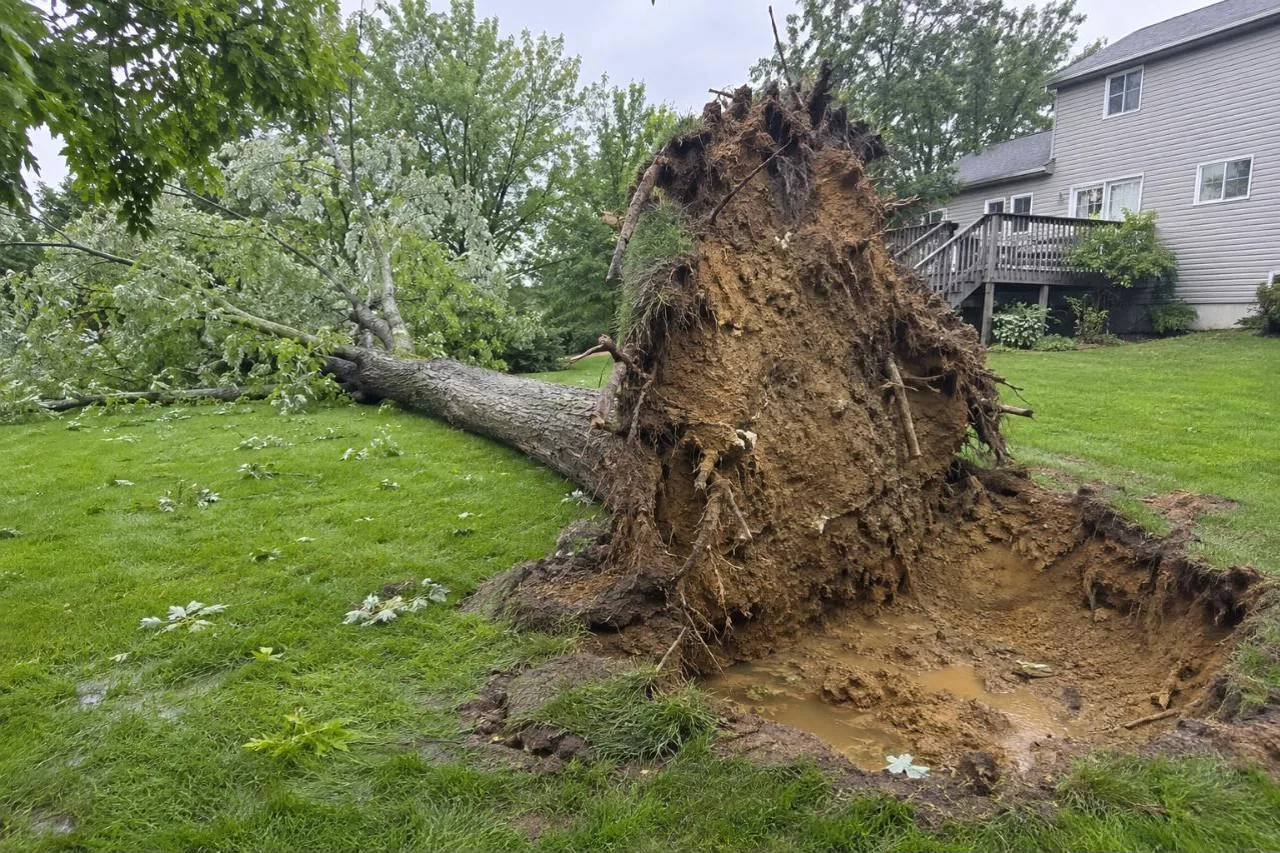
Some storm-thrown trees snap. Others, like the one in the photo, tip over, lifting a slab of roots and soil. Soil plays a part in that. Miamian, Ohio's state soil and one of the soils on the Warren County soils map, has a brown silt loam surface over clay. In its typical profile, the USDA describes dense, "very firm" glacial till starting about 33 inches down, with permeability "slow or very slow" in that layer. The same description lists roots only in the top 26 inches or so, and puts a perched seasonal high water table 30 to 42 inches down from January to May in normal years.
The USDA doesn't connect any of that to trees falling, so this next part is our reading: roots held mostly above a dense layer, in ground that stays wet through winter and spring, are a setup for a tree to go over whole in a strong wind. A tree that has started to lean, with the lawn cracking or lifting on the far side, deserves a look before the next storm.
Door-to-door crews and Ohio law
The Ohio Attorney General's office warned in August 2024 that "unscrupulous contractors are known to travel to storm-damaged communities," and that "typically, they go door to door, claiming that they can complete the work immediately."
Ohio's Home Solicitation Sales Act gives some protection. When a sale of $25 or more is made through a personal sales pitch at your home, you have until midnight of the third business day to cancel. The seller has to give you a copy of the signed agreement and a notice-of-cancellation form, must refund within 10 days of a cancellation, and may not begin the work until the three days have passed (Ohio AG business guide, checked Nov 10, 2026).
The emergency exception. The law doesn't cover a sale when you started the contact, the work is for "a bona fide immediate personal emergency" threatening health, safety or property, and you give the seller a separate dated statement, handwritten and signed by you, giving up the three-day right (Ohio Revised Code 1345.21, checked Nov 10, 2026). Read anything you're asked to write or sign after a storm carefully.
The Attorney General's 2024 advice for storm repairs: avoid large payments in advance, pay in stages as the work progresses, get a written contract that spells out "the costs, the work to be done, the starting and end dates," and consider paying by credit card. To report a problem, call 800-282-0515 or use OhioProtects.org (checked Nov 10, 2026).
One more thing to know: Ohio has no law aimed specifically at price gouging. The Attorney General said in 2020, "We don't have a price gouging law in Ohio," and a July 14, 2026 report from 13abc says that's still the case. State law against unconscionable sales practices applies instead (checked Nov 10, 2026). Agree on the price in writing before work starts.
Emergency prices
Urgent work costs more. Thumbtack's tree trimming guide, updated October 23, 2026, says emergency storm work is "sometimes as high as $250 an hour" (checked Nov 10, 2026). For an ordinary removal of one tree, the national average in its March 24, 2026 removal guide is $450 to $1,450, and that guide notes that delivering a large tree lift can run about $450 on its own (checked Nov 10, 2026). These are national figures; the contractor's written price for your job is the one that counts. See published prices.
Storm questions
The neighbor's tree fell on my house. Whose insurance pays?
Yours, at first. The Insurance Information Institute's 2010 guidance and the Ohio Insurance Institute's 2008 advice both say damage to your house is covered whether the tree was yours or the neighbor's. After that, your insurer may try to recover the cost from the neighbor's insurer, sometimes when the tree had been sickly or neglected.
A tree came down in my yard but didn't hit anything. Will insurance pay to remove it?
Generally not, under the 2010 guidance, unless it blocks a driveway or a ramp and your insurer covers that. Check your policy.
Lebanon's crew cut the tree off my line. Will they haul it away?
No. The city says that after storms its crews cut what's needed to restore power and leave the brush and wood on the property (checked Nov 10, 2026).
A crew knocked on my door and wants to start today. Is that allowed?
Under Ohio's home solicitation law, a seller who signs you up at your door can't start until your three-day cancellation period ends, unless the emergency exception applies, which requires your own handwritten, dated and signed statement waiving the right (checked Nov 10, 2026).
Can a crew charge anything it likes after a storm?
Ohio has no specific price gouging law, though its consumer sales law bans unconscionable practices (checked Nov 10, 2026). Get the price in writing before anyone starts.
When storm damage is reported here, the details reach one independent contractor who works around Lebanon and Mason. This site sends out no crews.
Sources
- National Weather Service, Wilmington, OH: Feb 13–14, 2007 ice storm, Sept 14, 2008 storm reports, May 1, 2012 tornado west of Lebanon, June 29, 2012 derecho, Mar 23, 2022 Clarksville tornado, May 7, 2024 South Lebanon tornado, May 7, 2024 tornado southwest of Lebanon.
- Stoppkotte and others, "14 September 2008 Ohio Valley High Wind Event Associated with the Remnants of Hurricane Ike" (National Weather Service); NOAA, Storm Data, June 2012; NWS, "The Historic Derecho of June 29, 2012" (January 2013).
- AP, Sept 15, 2008; WCPO, "From the Vault"; WHIO, Ike retrospective; Journal-News, June 15, 2022; FOX19, May 8, 2024.
- Ohio Department of Insurance storm tips, as reported Sept 15, 2008; Ohio Insurance Institute, via Farm and Dairy (Sept 16, 2008); Insurance Information Institute, fallen trees (July 22, 2010).
- City of Lebanon Electric Department, line clearance; Duke Energy, tree trimming practices; AES Ohio, what to expect; Ohio Consumers' Counsel, tree trimming. Checked Nov 10, 2026.
- USDA, Miamian series description (revised Nov 2021); Slater and Wilson, Miamian: Ohio State Soil; Warren County Regional Planning Commission, soils map; Ohio State University, "Ash Breakage: the Hazard Continues".
- Ohio Revised Code 1345.21; Ohio Attorney General, door-to-door sales and "Severe Weather Brings Out Scammers" (Aug 9, 2024); March 19, 2020 release; 13abc, July 14, 2026. Checked Nov 10, 2026.
- Thumbtack, tree trimming cost guide (updated Oct 23, 2026) and tree removal cost guide (updated Mar 24, 2026). National figures, checked Nov 10, 2026.