
How the borer reached Warren County
The emerald ash borer was found near Detroit in 2002 and identified in northwest Ohio, in Lucas County, in February 2003. A 2006 survey found it at a site south of I-70 in Warren County, and in October 2006 the Ohio Department of Agriculture widened its quarantine to cover all of the county.
Quarantines didn't stop it. When the federal government ended its domestic quarantine on January 14, 2021, the U.S. Department of Agriculture said the program "has been unable to prevent the spread of EAB," which by then had reached 35 states and the District of Columbia.
The losses are enormous. ODNR says the borer has killed hundreds of millions of ash trees in North America (checked Nov 10, 2026). Before it arrived, Ohio had nearly 4 billion ash trees, about one in every ten trees in the state, according to Ohio State University. Ash was part of the original forest on Miamian soils, along with white oak, maple, elm and hickory, according to the Soil Science Society of America's booklet on Ohio's state soil.
How long an infested ash usually lives, according to ODNR
Ash trees in Ohio before the borer, about 1 in 10 trees (Ohio State University)
Year the borer was found in Warren County and the whole county was quarantined (USDA Forest Service; Ohio Department of Agriculture)
It isn't finished
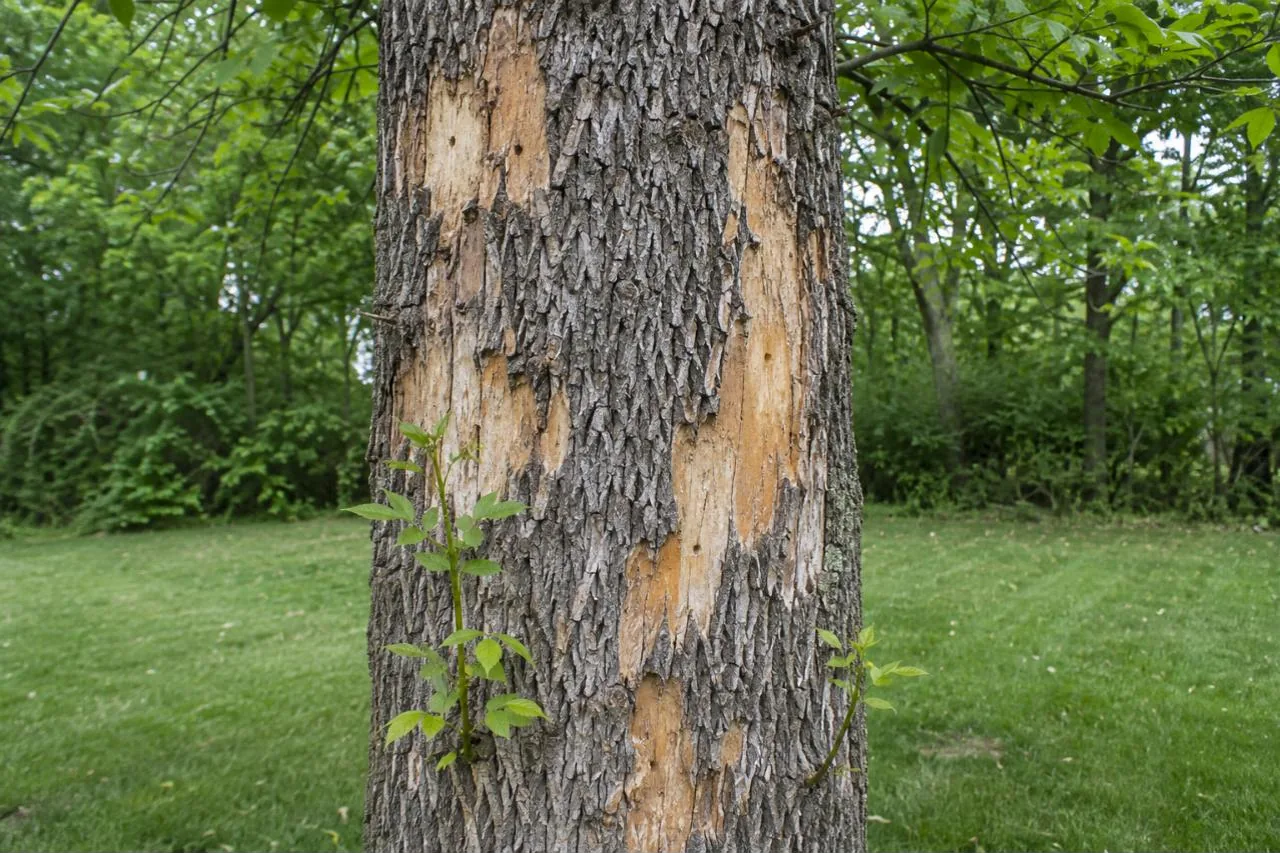
For a while it looked as if the borer had burned itself out in southwest Ohio. Ohio State's Joe Boggs and Amy Stone wrote in June 2023 that after killing so many trees, the beetle population here crashed, but "the beetles didn't completely disappear nor did the trees." Ash that resprouted as "bush ash" kept the borer going, yard ash that stopped being treated have begun to show obvious signs of infestation, and woodpecker damage is showing up on ash trunks again. Protection, they wrote, must continue "for the foreseeable future."
A July 1, 2026 update from Ohio State says the borer "is still present in our forests and landscapes infesting new ash seedlings," and that trees protected in the past "could be at risk if treatment is discontinued." Green and black ash are the most susceptible, white ash still dies at high rates, and blue ash is more tolerant but not immune.
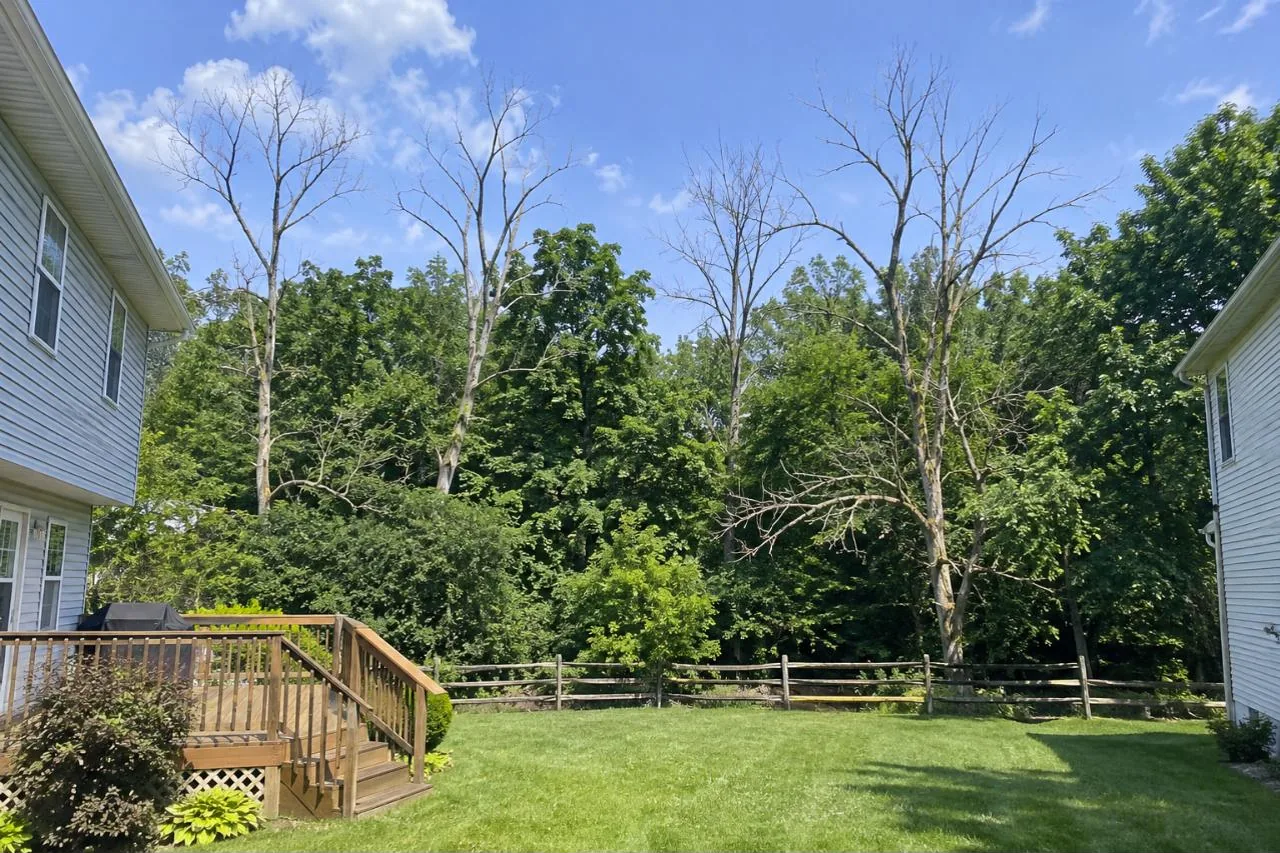
That leaves two kinds of trouble in Warren County yards: ash that died years ago and are still standing, and ash that were spared the first time and are dying now.
Why a dead ash is dangerous
Ash wood doesn't stay strong once the tree dies. Ohio State's report "Ash Breakage: the Hazard Continues" describes "continual failure of standing dead ash trees" as wood-rotting fungi digest the fibers that hold the tree up, and says dead ash wood "has little to no resistance to decay if exposed to the elements." Fungi such as turkey tail do that work, and the wind brings the tree down.
ODNR's state forester, Robert Boyles, has warned that standing dead ash have brittle limbs and trunks that can break or blow over easily. Ohio State's Amy Stone: "The longer the tree stands dead, the increased chance of it falling." A 2019 Ohio State report quoted Boggs saying standing dead ash "are starting to break apart," and said such trees can threaten "home, life, and limb."
Cutting one down is dangerous too. The same Ohio State breakage report says taking down unstable dead trees "is not a job for the faint of heart; inexperience can kill." This is not a weekend project.
Signs of the borer
Several signs together point to the emerald ash borer rather than ordinary decline:
| Sign | What to look for | Source |
|---|---|---|
| Exit holes | Small D-shaped holes in the bark, about 1/8 to 1/4 inch across | Ohio State ENT-77 |
| Galleries | Winding tunnels just under the bark, packed with frass; cracks in the bark over them | ENT-77; Herms and others, 2019 |
| Thinning crown | Dieback that starts at the top of the canopy | Ohio State, 2026 |
| Sprouts | Suckers from the base of the trunk, and shoots along the trunk and large branches | Ohio State, 2026; Herms, 2019 |
| Woodpeckers | Holes and flaked bark that leave the trunk looking lighter, or "blonde" | Ohio State, 2023 and 2026 |
The D-shaped hole is the telling one. Ohio State notes that "virtually every declining or dead ash tree will be at some point colonized by native borers," so holes alone don't prove anything, but the D shape belongs to the emerald ash borer.
Treat it or take it down?
A living ash can be protected. The 2019 Extension bulletin on insecticide options says emamectin benzoate applied in spring can control the borer "for up to three years," and that untreated trees usually decline over a three-to-five-year period once borer numbers peak. The question is how far gone the tree is.
Extension guidance says treatment works best early; once roughly 30% of the canopy is gone it becomes less effective, and past about half the canopy it's usually too late. (Ohio State, July 2026; Extension bulletin, April 2019; checked Nov 10, 2026.)
| The ash today | What the Extension guidance points to |
|---|---|
| Full, healthy crown | Treatment can protect it, and has to be kept up; Ohio State warns protected trees are at risk if treatment stops |
| Thinning, roughly 30% of the canopy lost (2026 guidance) | Treatment becomes less effective |
| About half the canopy or more gone | Usually too late to save |
| Dead or bare | Removal, before the wood weakens further |
A tree on the line between treat and remove is worth a careful look from the contractor, with the reasons for the recommendation written down.
How a dead ash comes down
Because the wood can't be trusted, a crew may choose not to climb a dead ash at all and work from a lift or bucket truck instead, lowering pieces rather than dropping a brittle trunk. Thumbtack's 2026 removal guide, last updated March 24, 2026, notes that delivering a 4x4 tree lift that reaches 120 to 150 feet can run around $450 on its own (checked Nov 10, 2026). Its national average for one tree, stump left, is $450 to $1,450, and a trunk 24 to 36 inches wide with a canopy over 30 feet runs $1,562 to $4,117 (checked Nov 10, 2026). Those are national figures; the contractor's written price for your tree is what counts.
Dead ash may stand in the wooded strip behind a row of houses, like the ones in the photo above. Before anyone cuts, find out whose ground the tree is on. If it's a neighbor's or an association's, the decision and the bill may not be yours, but a letter with photos puts the hazard on record.
City rules that apply to ash
- Lebanon. The code counts the tree lawn as part of the street, so treat an ash there as a public tree: work on a public tree needs a right-of-way permit from the Director of Service (907.03). The city can also designate a tree along the right-of-way as dead, dying, diseased or hazardous and give the owner 30 days to remove it (907.07). Service Department: (513) 933-7200 (checked Nov 10, 2026).
- Mason. The city can order removal of dead or diseased hazardous trees on private property with 60 days' written notice and charge the cost to the property tax bill if the owner doesn't act. Its street tree list rules out "All Ash Trees" (checked Nov 10, 2026).
- Springboro. Diseased trees and trees that threaten public health or safety don't need the city's protected-tree removal permit (280.03, checked Nov 10, 2026).
- Near the wire to the house. Lebanon will temporarily shut off your service line during normal business hours if you call (513) 228-3210 at least two business days ahead. In Lebanon and in AES Ohio's area, clearing the service line is the owner's job. Duke Energy asks customers to call and have the line de-energized before tree work near a service drop (checked Nov 10, 2026).
Details for each city are in the permits and rules guide.
What to do with the wood
The federal ash borer quarantine ended in January 2021, but ODNR still asks people to keep firewood close to home: "Burn it where you buy it." Separately, Ohio's statewide spotted lanternfly quarantine, in effect since February 17, 2026, requires trees and nursery stock leaving Ohio to have a compliance agreement or permit, or to pass inspection (checked Nov 10, 2026).
The cities won't take a whole ash at the curb. Mason's brush pickup stops at branches 4 inches thick and doesn't take trunks, stumps or root balls; Lebanon collects yard waste bundled in 4-foot sections or bagged (checked Nov 10, 2026). Settle with the contractor whether the wood is hauled, chipped or left in rounds. Burning rules are on the permits page.
What to plant in its place
Don't replace an ash with another ash, or with a Callery pear, which Ohio has barred from sale since January 7, 2023. Some options from local and state lists (checked Nov 10, 2026):
- Native small trees ODNR has suggested: serviceberry, eastern redbud, flowering dogwood, eastern hophornbeam, American hornbeam, yellowwood, hawthorn, blackgum, American plum and chokecherry.
- Large trees on Mason's recommended list: red maple, sugar maple, swamp white oak, red oak, Shumard oak, Kentucky coffeetree, 'Redmond' linden, silver linden, lacebark elm and bald cypress.
- From Springboro's street tree list: sugar maple and white oak among the larger trees, flowering crabapple among the smaller ones.
Under overhead wires on public land, Lebanon allows only small species from its Shade Tree Commission list, and the city's Electric Department asks that all plants be kept at least 10 feet from its poles and equipment (checked Nov 10, 2026).
Ash tree questions
How long does an ash take to die once the borer is in it?
ODNR says an infested ash usually dies in less than five years. The 2019 Extension bulletin describes untreated trees declining over three to five years once borer numbers peak.
Can a dead ash be saved?
No. Treatment protects living trees, and Extension guidance says it's usually too late once about half the canopy is gone.
I treated my ash years ago. Is it safe now?
Not necessarily. Ohio State's 2026 update says previously protected trees "could be at risk if treatment is discontinued," because the borer is still infesting ash in Ohio.
Can I cut down a dead ash myself?
Ohio State warns that taking down unstable dead trees "is not a job for the faint of heart; inexperience can kill." Brittle wood can break in ways a cutter doesn't expect.
Is there still an ash quarantine?
The federal quarantine was lifted on January 14, 2021. ODNR still asks people not to move firewood far, and Ohio's separate spotted lanternfly quarantine covers trees and nursery stock leaving the state (checked Nov 10, 2026).
An ash request made here reaches one independent contractor working in Warren County, who sizes up the tree and names their own price. This site does no tree work.
Sources
- USDA Forest Service, Ohio Forest Health Highlights 2006; Farm and Dairy, Oct 12, 2006; Federal Register, removal of the EAB domestic quarantine (Dec 15, 2020).
- ODNR Division of Forestry release, reposted by Deerfield Township.
- Ohio State University: "Beware of falling ash trees"; April 25, 2019 report; "Ash Breakage: the Hazard Continues"; "Is Emerald Ash Borer on the Rebound in Ohio?" (June 14, 2023); "Emerald Ash Borer Still Infesting Trees" (July 1, 2026); ENT-77, Distinguishing Emerald Ash Borer from Native Borers (March 4, 2016); statewide spotted lanternfly quarantine.
- Herms and others, Insecticide Options for Protecting Ash Trees from Emerald Ash Borer (3rd ed., April 2019).
- Slater and Wilson, Miamian: Ohio State Soil.
- City of Lebanon, 907.03, 907.07, 907.11, line clearance, new plantings, refuse and recycling; City of Mason, Chapter 939 (revised Nov 18, 2013) and brush collection; City of Springboro, 280.03 and 280.041 street tree list. Checked Nov 10, 2026.
- AES Ohio, what to expect; Duke Energy, tree trimming practices; OSU Extension, Highland County newsletter (Feb 2023); Ohio Administrative Code 901:5-30-01. Checked Nov 10, 2026.
- Thumbtack, Tree Removal Cost Guide 2026 (last updated Mar 24, 2026). National figures, checked Nov 10, 2026.