
Warning signs to act on
No list can say when a particular tree will fail. Ohio State University's Joe Boggs says of dead ash that "they can snap at any time without warning." What a list can do is point to trees that deserve a closer look now rather than after the wind picks up.
| What you see | Why it matters |
|---|---|
| An ash with no leaves in summer | Dead ash turns brittle; ODNR says limbs and trunks can break or blow over easily. |
| An ash thinning from the top down, with sprouts at the base | Ohio State lists canopy dieback starting at the top and suckers from the trunk base as signs of emerald ash borer. |
| Pale, flaked patches of bark on an ash | Ohio State says heavy woodpecker feeding on borer larvae strips the bark and leaves ash looking lighter, or "blonde," and that this damage was showing up again in southwest Ohio in 2023. |
| Small D-shaped holes, about 1/8 to 1/4 inch across | Exit holes left by the emerald ash borer (Ohio State fact sheet ENT-77). |
| Shelf fungi such as turkey tail on dead wood | Ohio State says decay fungi break down dead ash wood, and the wind brings the trees down. |
| A Callery or Bradford pear with tight, narrow forks | Ohio State Extension calls out "the infamous weak branch structure of the Bradford cultivars." |
| Half the crown bare while the rest is green | Part of the tree has died. Whatever the cause, those dead limbs are over something. |
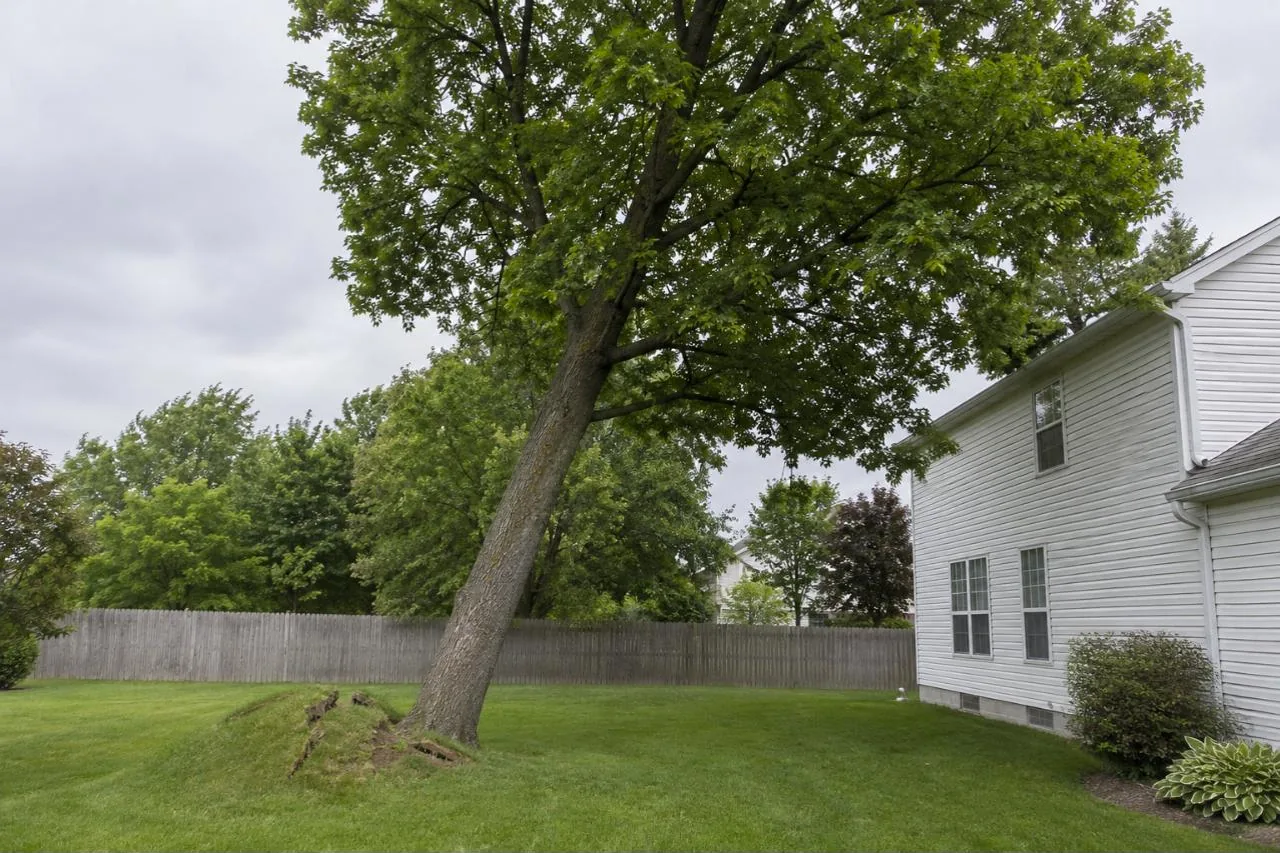
| A new lean, with the lawn cracked or raised on the far side | The roots on that side may be lifting. Have it looked at soon, especially if the lean appeared after a storm. |
Dead ash comes first
In Warren County, start with the ash trees. The emerald ash borer was found in the county in 2006, an infested ash usually dies in less than five years according to ODNR, and Ohio had nearly 4 billion ash trees, about one in ten, before the beetle arrived, according to Ohio State.
Ohio State's Amy Stone says, "The longer the tree stands dead, the increased chance of it falling." A 2019 Ohio State report quoted Boggs warning that standing dead ash are "starting to break apart," and said such trees can threaten "home, life, and limb." The ash tree guide covers the signs and what can still be treated.
Callery and Bradford pears
Callery pear, including the Bradford variety, is the white-flowering tree that Ohio State Extension singles out for its weak branch structure, and the state has since turned against it: Ohio's invasive plant rule has barred selling, propagating or distributing Callery pear since January 7, 2023. Mason's landscape code lists Bradford pear among the trees it won't accept as street trees (checked Nov 10, 2026).
Ohio State also says plainly that "existing trees do not require removal," so a healthy pear can stay. The trouble is the forks. If yours has already lost one big limb, ask whether the rest of it can be made safe or should come down. If it's replaced, ODNR has suggested native small trees such as serviceberry, eastern redbud, flowering dogwood, American hornbeam and blackgum.
Leaning trees
A lean that's new deserves attention, especially if it showed up after a storm or a long wet spell. Look at the ground on the side away from the lean, as in the photo above. Cracked, raised or mounded soil there may mean the root plate is starting to lift.
Warren County's soils can make that worse. In the USDA's description of Miamian, one of the soils on the county's map, dense, very firm till starts about 33 inches down in the typical profile and drains slowly or very slowly. The description lists roots only in the top 26 inches or so and notes a perched water table 30 to 42 inches down from January to May in normal years. The USDA doesn't tie that to falling trees, so this is our reading: shallow roots in ground that stays wet in winter and spring are a setup for trees to tip over whole. On May 7, 2024, a small EF0 tornado southwest of Lebanon snapped or uprooted 10 to 15 trees at a single home in the Hillcrest area, the weather service found.
If a leaning tree could reach the house, a driveway, a play set or a street, treat it as urgent. See storm and emergency work if it has already moved.
A crown that's half dead
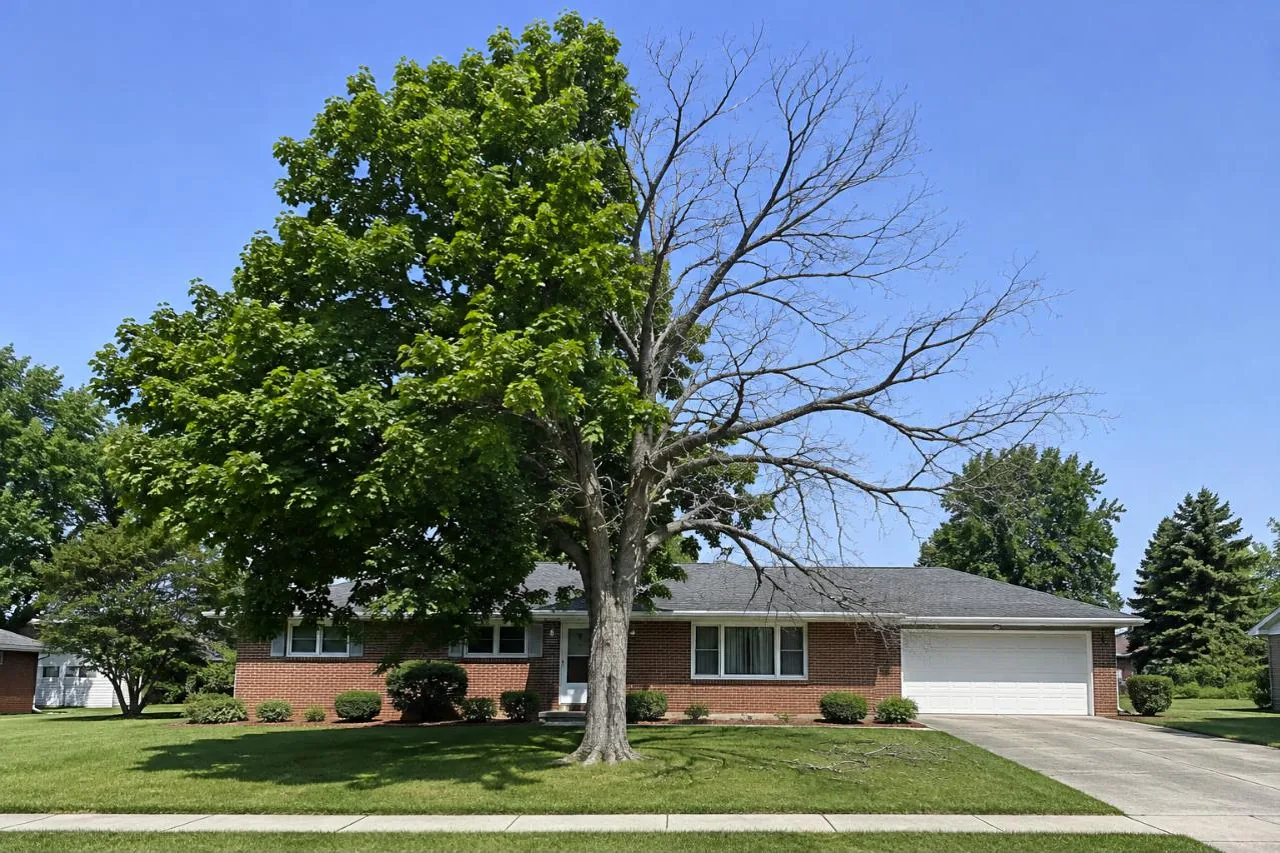
When one side of a tree leafs out and the other doesn't, something has killed that part of the tree. The cause matters less than where the dead limbs are. In the photo, they hang over a driveway, which means over cars and people walking to them.
A contractor can tell you whether the dead side can be cut out and leave a tree worth keeping, or whether what's left would be lopsided and weak. If the tree is an ash that has lost half its crown, Extension guidance suggests it's usually past saving. Get the recommendation and its reasons in writing.
When the city steps in
A dead or hazardous tree near a street isn't only the owner's business.
- Lebanon. Under Section 907.07, owners of property bordering a right-of-way must remove trees or shrubs the city designates as dead, dying, diseased or hazardous. The city sends written notice and allows 30 days. If the work isn't done, the city or its contractor may enter and do it, and the owner pays all costs, including administrative charges (checked Nov 10, 2026).
- Mason. Under the 2013 version of Chapter 939 on the city's site, the City Manager has authority over private trees judged a menace to public property, safety or welfare. The city may order removal of dead or diseased hazardous trees or overhanging branches on private property, with written notice and 60 days to comply. If the owner doesn't act, the city may remove them and add the cost to the property tax bill (checked Nov 10, 2026).
- Springboro. Its tree-removal permit for protected trees doesn't apply to diseased trees or trees that threaten public health or safety (Section 280.03, checked Nov 10, 2026).
Dealing with a hazardous tree before a notice arrives keeps the choice of contractor, timing and price in your hands.
When it's the neighbor's tree
If a neighbor's dead tree leans toward your house, the rules for who pays depend on what happens next. A 2016 FOX19 explainer on trees falling across property lines says your own insurer pays first if it hits your house, and that a neighbor is mainly liable when they knew the tree was a hazard. For a neighbor's dead tree, it suggests sending a letter with photos asking them to deal with it. The Insurance Information Institute's 2010 guidance adds that your insurer may pursue the neighbor's insurer, sometimes when the tree was in poor health or poorly maintained.
A dated, written letter with photos puts the hazard on record. Keep a copy.
Can it still be saved?
For ash, there's a clear line. Extension guidance says treatment works best early; once roughly 30% of the canopy is gone it becomes less effective, and past about half the canopy it's usually too late. (Ohio State, July 2026; Extension bulletin, April 2019; checked Nov 10, 2026.) A spring treatment with emamectin benzoate can control the borer for up to three years, according to the 2019 Extension bulletin on ash protection, and Ohio State warns that protected trees can become vulnerable again if treatment stops.
For other trees, there's no single rule. A contractor looking at the trunk, the root zone and the crown can say what they'd do and why. If the answer is removal, see tree removal.
Questions about dead and leaning trees
How can I tell when a dead tree will fall?
You can't. Ohio State says dead ash can snap at any time without warning, and that the chance of a fall grows the longer the tree stands dead. Decay keeps working whether or not the wind blows.
Can Lebanon make me take down a dead tree?
If the tree borders a right-of-way and the city designates it dead, dying, diseased or hazardous, yes. You get written notice and 30 days, after which the city can do the work and bill you for it (checked Nov 10, 2026).
Is my Bradford pear illegal now?
No. Since January 7, 2023, Ohio bars selling and propagating Callery pear, but Ohio State says existing trees do not require removal. Whether yours should stay depends on its forks and what it stands over.
The neighbor's dead tree leans toward my house. What should I do?
Write to the neighbor with photos and keep a copy, as FOX19's 2016 explainer suggests. If the tree is along a street in Lebanon or Mason, the city may also take an interest in a hazardous tree.
Will my insurance pay to take down a dead tree before it falls?
The 2010 insurance guidance describes coverage for trees that fall on something insured; it doesn't describe paying to take down a standing tree. Ask your insurer before counting on it.
Describe a dead or leaning tree here and one independent Warren County contractor gets the details. Nobody at this site assesses or cuts trees.
Sources
- Ohio State University Extension: "Beware of falling ash trees"; "Danger: borer-killed ash trees overhead" (April 25, 2019); "Is Emerald Ash Borer on the Rebound in Ohio?" (June 14, 2023); "Emerald Ash Borer Still Infesting Trees" (July 1, 2026); ENT-77 (March 4, 2016); "The Ball Drops on Callery Pear in 2023!"; Highland County newsletter (Feb 2023).
- ODNR Division of Forestry release, reposted by Deerfield Township; USDA Forest Service, Ohio Forest Health Highlights 2006.
- Herms and others, Insecticide Options for Protecting Ash Trees from Emerald Ash Borer (3rd ed., April 2019).
- Ohio Administrative Code 901:5-30-01. Checked Nov 10, 2026.
- City of Lebanon, 907.07; City of Mason, Chapter 939 (revised Nov 18, 2013); City of Springboro, 280.03. Checked Nov 10, 2026.
- USDA, Miamian series description; NWS Wilmington, May 7, 2024 tornado southwest of Lebanon.
- FOX19, "Tree falls over property line" (March 14, 2016); Insurance Information Institute, fallen trees (July 22, 2010).